


Indian consumers no longer need a reason to buy beauty products online. From everyday makeup and skincare to premium beauty and personal care, modern shoppers already prefer beauty products multi vendor marketplaces to explore multiple brands, sellers, products, prices, discounts, and offers in one place.
The growing preference of customers for choice, convenience, and personalised experiences has made building a multi vendor marketplace a strong opportunity for enterprises looking to bring multiple beauty brands and sellers together on a single platform.
Several trusted online marketplaces are already thriving in the beauty and personal care space. Their success shows how the right combination of product selection, attractive offers, personalised discovery, seamless shopping experiences, and technology can keep customers coming back to the platform.
So, what can enterprises learn from these platforms when building their own beauty marketplace? Let’s look at the five leading players in India and the strategies and technology capabilities shaping their success.
Table of Contents
Key Trends Driving the Growth of Makeup and Beauty Products Multi Vendor Marketplace
The way people discover and shop for makeup and personal care products is changing quickly. Shoppers are becoming more comfortable buying online, while personalised discovery, wider product choices, and faster delivery are making it easier to explore new products and brands. These shifts are creating a strong opportunity for businesses to build online marketplaces that bring multiple sellers and a wider product selection together.
Let us look at a few make-up and beauty industry trends to understand the market well.
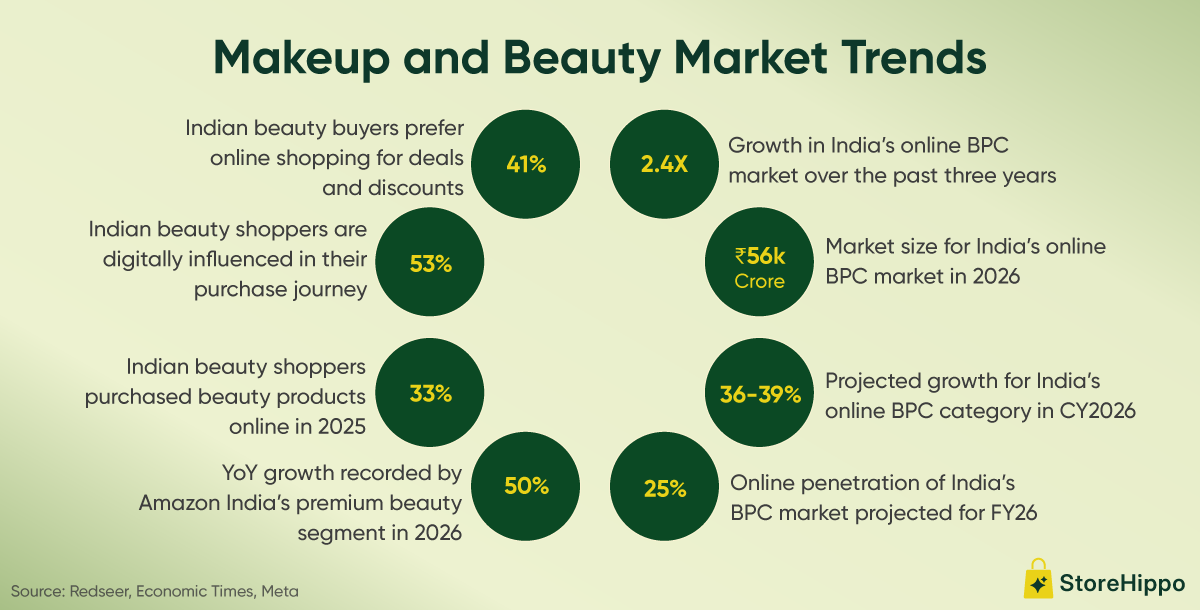
- 2.4X is the growth in India’s online BPC market in three years (CY2022-CY2025)
- ₹56,000 Cr is India’s online BPC market size in 2026
- 36-39% is the projected growth of India’s online BPC category in CY2026
- 25% is the online penetration of India’s BPC market in FY26
- 50% YoY growth of Amazon India's premium beauty segment in 2026
- 33% of Indian beauty shoppers bought online in 2025, up from 11% in 2021
- 53% of Indian beauty shoppers are digitally influenced (compared with 18% in 2021)
- 41% of Indian beauty buyers prefer shopping online because of deals and discounts
Source : Redseer, Economic Times, Meta
The numbers tell a clear story: Modern shoppers increasingly prefer to shop for beauty products online for greater choice, convenience, and better deals. As customers explore more brands and product categories online, businesses that build scalable beauty products multi vendor marketplaces can bring multiple sellers together and create the wide, convenient shopping experience new-age beauty shoppers expect.
The shift towards online beauty shopping is already visible, with leading platforms bringing thousands of products and brands within easy reach of customers. Here are five platforms that are changing the way consumers discover and shop for makeup and personal care products in India.
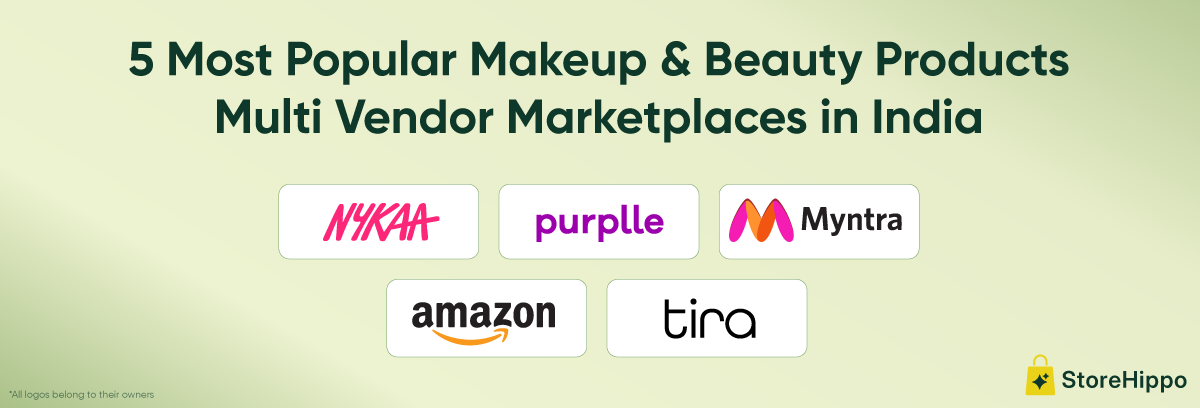
The Top 5 Online Beauty Products Multi Vendor Marketplace In India
From makeup and skincare to haircare, fragrances, and grooming, online marketplaces are bringing a wide range of beauty products and brands together in one place. These multi vendor marketplaces make it easier for shoppers to discover new products while giving sellers access to a larger customer base.
Let’s explore five leading BPC multi vendor marketplaces shaping online makeup and personal care shopping in India and the strategies helping them stand out:
1. Nykaa
Nykaa has grown into one of India’s most recognised online beauty marketplaces, bringing a wide range of brands and beauty products together in one place. Its focus now goes beyond simply listing products, with personalised recommendations, premium brands, and faster delivery shaping the shopping experience. In FY26, its beauty GMV grew 27% YoY to ₹3,892 crore in Q4, while its customer base reached around 45 million, growing by more than 20% year over year. Its Nykaa Now service has also completed more than 2 million orders across seven cities by October 2025, adding faster fulfilment to its beauty products multi vendor marketplace experience.
Top Winning Strategies Behind Its Success:
- AI-powered marketplace with AI personalisation and discovery that uses customer signals to make product recommendations and shopping experiences more relevant, including AI-powered personalisation for newer customers with limited browsing history.
- Premium and exclusive brand portfolio with 200+ new brands launched in FY26 and partnerships with leading global beauty groups, helping Nykaa strengthen its position across luxury, premium and mass-market categories.
- Fast beauty fulfilment through Nykaa Now, offering 60-120 minute delivery across seven cities. The service had fulfilled 2 million+ orders through 53 rapid delivery hubs by October 2025.
- Unified omnichannel beauty experience connecting its ecommerce platform, mobile experience and physical stores, with 313 stores across 99 cities by the end of FY26.
2. Purplle
Purplle is one of India’s leading makeup and beauty products multi vendor marketplaces, offering a wide range of beauty products from multiple brands and sellers. Its digital-first approach focuses on personalised product discovery, private labels, and value-driven offerings. With a strong presence across Tier-2 and Tier-3 cities, Purplle continues to expand access to beauty products beyond India’s largest urban markets.
Top Winning Strategies Behind Its Success:
- AI-powered beauty recommendations through its Beauty Assistant and personalised discovery tools, helping shoppers find products based on their individual beauty needs.
- AI-powered operations and automation to streamline activities such as customer engagement, campaigns and retail operations, reducing repetitive manual work.
- Mobile-first shopping experience through its app, giving customers easy access to product discovery, personalised recommendations, offers, payments and beauty content.
- Omnichannel expansion that connects its digital platform with its growing physical retail presence, allowing customers to engage with the brand across multiple shopping touchpoints.
3. Myntra
Myntra has made beauty a strong growth category alongside its core fashion business. In 2026, its beauty products multi vendor marketplace brings together 4,000+ brands and 1.75 lakh SKUs, with Gen Z making up around 60% of its beauty shoppers. Beauty also contributes nearly 20% of new customers joining the platform. Myntra is further driving product discovery through content commerce, working with 80,000-90,000 active creators across beauty and personal care.
The platform is also seeing growing interest in international beauty products. K-beauty on Myntra grew by around 200% YoY, based on the company’s December 2025 data, while nearly 45% of demand for international brands came from non-metro markets. This mix of wide selection, , and growing demand beyond major cities strengthens Myntra’s position as a beauty products multi vendor marketplace.
Top Winning Strategies Behind Its Success:
- Fashion-meets-beauty shopping that allows customers to discover makeup, skincare, haircare and other personal care products alongside fashion and lifestyle products.
- Mobile-first commerce that makes product discovery, personalised recommendations, payments and purchases convenient for its large base of app-based shoppers.
- Creator-based and content-driven discovery using beauty creators and shoppable content to introduce customers to new products, trends and brands.
- AI and personalised recommendations that use shopper behaviour and preferences to make product discovery more relevant and improve the overall shopping journey.
- Strong international beauty assortment, including growing demand for K-beauty and global brands, while expanding reach among non-metro shoppers.
4. Amazon India
Amazon gives beauty brands access to a large online customer base across India, including shoppers in Tier-2 and Tier-3 cities. Its premium beauty segment grew 50% YoY in 2026, with more than half of premium beauty demand coming from these emerging markets. Amazon is also expanding its premium beauty selection, with plans to add 100+ premium brands during 2026, strengthening its position as a beauty products multi vendor marketplace.
Top Winning Strategies Behind Its Success:
- Generative AI-powered shopping assistance through Rufus, helping shoppers ask questions, compare products and receive personalised recommendations while browsing beauty products.
- AI-powered visual discovery through Lens, allowing shoppers to use images to find similar products and discover relevant beauty items.
- Virtual beauty experiences including Virtual Try-On and SkinCare Advisor, helping shoppers explore products and make more informed purchase decisions.
- Premium and international brand expansion, with Amazon planning to add 100+ premium beauty brands in 2026 to strengthen its beauty assortment.
- Fast and convenient fulfilment supported by Amazon's delivery network and newer quick-commerce options, making beauty essentials easier to purchase when customers need them.
5. Tira Beauty
Tira is one of the newer names in India’s beauty ecommerce market, but it has quickly established a strong presence under Reliance Retail. The platform brings online beauty shopping and physical retail together, while focusing on premium brands and personalised beauty experiences. From makeup and skincare to haircare, fragrances, and wellness, Tira offers shoppers a convenient destination to explore a wide range of beauty products in one place.
Top Winning Strategies Behind Its Success:
- AI-powered beauty assistance through its Virtual Beauty BFF, helping shoppers discover personalised makeup and skincare recommendations.
- Virtual try-on and interactive discovery through tools such as Look Studio and Virtual Try-On, allowing customers to explore shades and looks before purchasing.
- Omnichannel beauty shopping connecting its website, marketplace app and physical stores to give customers multiple ways to discover and purchase products.
- Premium and international brand portfolio featuring brands such as Fenty Beauty and Fenty Skin, helping Tira attract shoppers looking for premium and global beauty products.
- Personalised beauty journeys using beauty quizzes, buying guides, tailored content and recommendations to make product discovery more relevant to individual shoppers.
The success of these online beauty marketplaces highlights the growing demand for digital platforms that bring customers, beauty brands, and sellers together. To build a beauty products multi vendor marketplace like these, businesses need the right technology foundation to manage sellers, product catalogues, orders, payments, and customer experiences at scale.
Which Features Are Essential for Scaling a Beauty Products Multi-Vendor Marketplace?
A scalable multi vendor marketplace for beauty and personal care needs more than seller onboarding and a wide product catalogue. It also requires flexible business workflows, seamless integrations, intelligent product discovery and the ability to support new sales channels as the business grows.
StoreHippo brings these capabilities together on one AI-powered marketplace platform, helping businesses build, manage and scale their beauty and personal care marketplace efficiently.
Here is how StoreHippo helps enterprises build, manage and scale a beauty and personal care multi vendor marketplace:
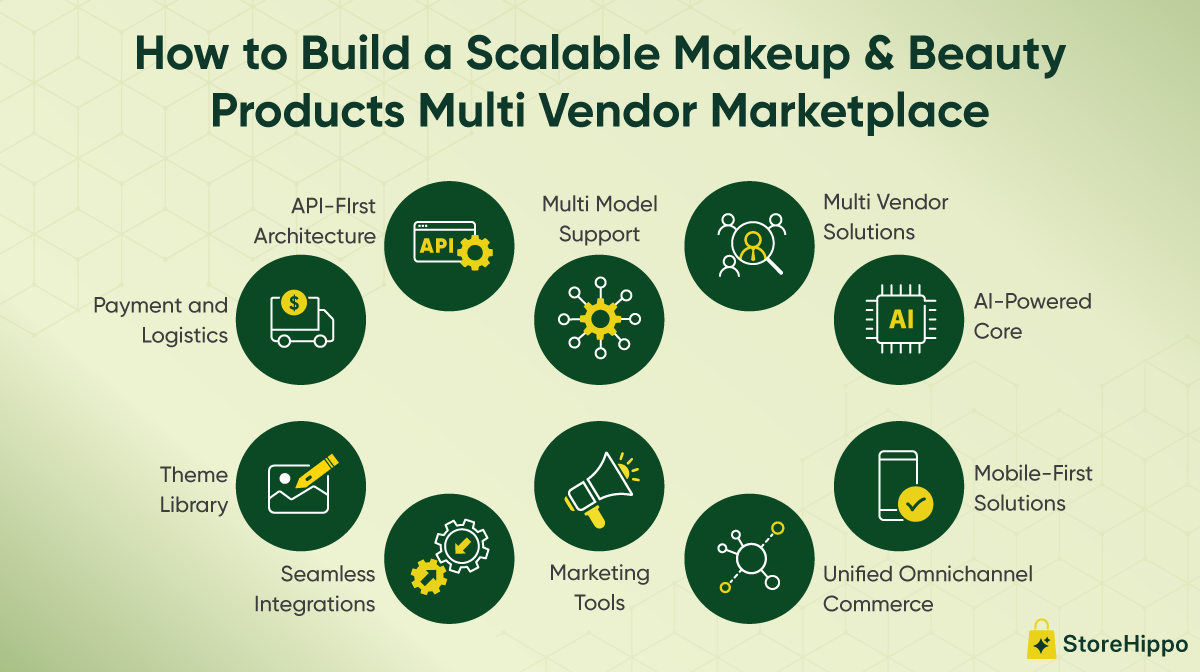
- Complete multi vendor marketplace solutions to onboard and manage multiple sellers, beauty brands, cosmetics retailers, skincare businesses, salons, and personal care providers from a single platform. Sellers can manage their products,inventory,orders, and day-to-day marketplace activities through dedicated dashboards, while marketplace owners maintain centralised control through central admin panel.
- StoreHippo is an AI-powered marketplace platform with AI built into its core. It offers built-in AI tools including AI-powered product discovery, semantic search, automated catalogue creation, image editing too, Magic Edit , personalised recommendations, and ability to built custom AI shopping assistant and support bots. These capabilities simplify online marketplace operations while making it easier for shoppers to discover relevant beauty and personal care products.
- Mobile-first commerce solutions to build Android and iOSmarketplace appsandPWA stores. Businesses can offer shoppers convenient mobile experiences for browsing, product discovery, comparisons, and purchases across makeup, skincare, haircare, fragrances, grooming, and other personal care categories.
- Unified omnichannel commerce solutions that connect websites, marketplace apps, WhatsApp, conversational commerce, voice commerce, and other sales channels. Businesses can manage products, orders, customers, and marketplace operations from a centralised dashboard instead of managing every channel separately.
- Unified conversational dashboard to manage and respond to customer conversations across multiple channels from an AI-poweredunified dashboard. Teams can route requests, take actions, and resolve customer queries from a connected interface.
- Built-in marketing tools includingSEO tools,discount engine, loyalty programmes, personalised promotions, abandoned cart recovery, and push notifications. These tools give enterprises multiple ways to attract shoppers, promote products, increase conversions, and drive repeat purchases on their beauty products marketplace.
- Seamless integrations through 150+ well connected APIs, enabling enterprises to connect their BPCmulti vendor marketplace with essential business systems and software. This makes it easier to extend functionality as the seller network, catalogue, order volumes, and customer base expand.
- Pre-integrated payment solutions with 60+payment gateways, giving shoppers flexible and secure payment options while simplifying payment management for marketplace admins and vendors.
- Integrated logistics solutions with 30+ pre-integrated logistics providers to manage fulfilment and deliveries efficiently. Businesses can streamline shipping operations of beauty products and offer reliable delivery experiences across their beauty and personal care multi vendor marketplace.
- AI store builder to simplify and speed up online store creation with AI-generated storefront designs, tailored content, and brand-aligned shopping experiences. Businesses can use their brand details, product images, and business information to create a storefront that fits their requirements, reducing manual effort and helping them launch their beauty and personal care marketplace faster.
- Built on Flexible headless and API-first architecture which gives BPC enterprises the flexibility to connect existing systems, build customised experiences, and introduce new commerce touchpoints without rebuilding their core marketplace infrastructure.
- Built-in support for different business models, enabling enterprises to expand their marketplace across new sellers, beauty brands, categories, channels, and markets as their business grows. This provides the flexibility to evolve from a niche beauty marketplace into a broader beauty and personal care multi vendor marketplace.
StoreHippo gives enterprises everything they need to launch and grow a beauty and personal care multi vendor marketplace without making technology a daily headache. From managing sellers and products to improving discovery, marketing, payments, and fulfilment, businesses can handle major marketplace activities from one platform and focus on building their brand and customer base.
Businesses can use StoreHippo to create focused skincare or makeup marketplaces or build larger platforms covering haircare, fragrances, cosmetics, grooming, wellness, and personal care. As the marketplace grows, they can add more sellers, categories, and sales channels without starting over.
Conclusion
India’s beauty and personal care market is opening up new opportunities for enterprises that can bring brands, sellers, and shoppers together through a seamless online experience. As customers discover more products online and expect personalised, convenient shopping journeys, businesses need a marketplace platform that can keep pace with changing demands.
StoreHippo gives enterprises the tools to build a beauty products multi vendor marketplace that is easy to manage now and ready to grow tomorrow. From AI-powered discovery and mobile commerce to omnichannel selling, seller management, marketing, payments, and logistics, businesses can bring their key marketplace operations together on one platform.
Want to build and scale a beauty and personal care multi vendor marketplace?
Book a demo with AI-powered marketplace platform StoreHippo now.
FAQs
1. How can enterprises build a scalable BPC multi vendor marketplace?
Enterprises can build a scalable BPC multi-vendor marketplace with StoreHippo’s enterprise-grade architecture and built-in marketplace capabilities. From vendor onboarding and catalogue management to adaptive payments, order processing and marketing, StoreHippo brings essential operations onto one platform, helping enterprises efficiently manage multiple sellers, handle growing transaction volumes and expand their beauty marketplace without adding unnecessary technology complexity.
2. How can enterprises use AI to create personalised customer journeys on a beauty marketplace?
Enterprises can use AI to create personalised customer journeys by analysing browsing behaviour, purchase history, preferences and real-time interactions. AI can deliver relevant product recommendations, personalised offers, search results and notifications across the beauty marketplace. This helps enterprises make product discovery more relevant, improve customer engagement and create consistent shopping experiences across web, marketplace apps and other channels.
3. Can enterprises manage a beauty marketplace without relying on multiple plugins?
Yes. Enterprises can manage a beauty marketplace without multiple plugins by choosing an integrated ecommerce platform with built-in vendor management, catalogue, inventory, payments, marketing, order management and analytics capabilities. A unified technology stack reduces integration dependencies, simplifies maintenance and creates a consistent operational environment, making it easier to manage multiple sellers and scale marketplace operations efficiently.
4. What role does unified commerce play in scaling an enterprise beauty marketplace?
Unified commerce connects multiple sales channels, enabling enterprises to manage customer interactions, inventory, orders and sales through a connected ecosystem. For a beauty marketplace, this creates consistent experiences across websites, marketplace apps, whatsapp, social media, offline stores, channels and other touchpoints. It also provides centralised visibility, helping enterprises streamline operations, improve fulfilment and deliver more relevant customer experiences.
5. Where can AI help enterprises speed up BPC multi vendor marketplace operations?
AI can help enterprises speed up BPC multi-vendor marketplace operations by automating catalogue enrichment, product tagging, search, recommendations, inventory analysis and customer support. It can process large datasets quickly, identify operational patterns and reduce repetitive manual tasks. This enables marketplace teams to respond faster, improve accuracy, streamline workflows and focus resources on strategic growth and customer experience.
6. How can enterprises use m-commerce to increase beauty product sales on their multi vendor marketplace?
Enterprises can use m-commerce to increase beauty sales by offering fast, mobile-first shopping experiences through marketplace apps and responsive websites. Features such as personalised recommendations, one-click checkout, mobile payments, push notifications and location-based offers can encourage repeat purchases and impulse buying. Optimising product discovery and checkout for smartphones also helps enterprises reach customers across metros and emerging markets.
7. How can enterprises recover abandoned carts on a beauty and makeup products marketplace?
Enterprises can recover abandoned carts on a beauty and makeup products marketplace through timely reminders, personalised offers and seamless retargeting campaigns. Automated email, SMS, WhatsApp and push notifications can bring shoppers back to their carts. Enterprises can also identify checkout friction, simplify payment flows and offer relevant incentives to improve completion rates without relying solely on discounts.
8. How can enterprises manage fast and reliable deliveries for a BPC marketplace?
Enterprises can manage fast and reliable deliveries on a BPC marketplace by integrating multiple logistics partners, automating order allocation and tracking shipments in real time. Location-based inventory and serviceability can help route orders efficiently and reduce delivery delays. Enterprises can also use delivery analytics to monitor performance, optimise fulfilment operations and maintain consistent customer experiences across regions.
Binny Joseph is a seasoned ecommerce and enterprise growth leader, serving as Senior Vice President of Sales & Alliances with deep experience helping global brands adopt modern commerce solutions.
He brings practical insights into the technologies and strategies businesses need to build, manage, and scale successful niche marketplaces.