


Picture this: A B2B marketplace where you’re not only getting products to customers faster but also cutting delivery times and strengthening local relationships all at once.
Sounds pretty great, right?
That’s exactly what a hyperlocal distributor-based B2B marketplace does, it brings everything closer, making business smoother and more personal.
Partnering with local distributors helps you streamline logistics, reduce costs, and provide faster, more efficient service to your customers.
This model doesn’t just optimise your operations; it positions your business for sustainable growth in local markets.
Wondering how could it could benefit your business?
Before we dive into the top 7 benefits of building a distributor-based hyperlocal business-to-business marketplace, let us understand the hyperlocal B2B setup.
Table of Contents
What is a Distributor Based Hyperlocal B2B Marketplace
A B2B distributor-based hyperlocal marketplace is an ecommerce setup that connects businesses with local distributors to streamline the buying and selling process. Unlike traditional business-to-business marketplaces, here the focus is on hyperlocal ecommerce. It connects businesses with distributors in their area, enabling faster, more efficient transactions.
When you build a B2B hyperlocal marketplace, you support local businesses and reduce logistics costs. Local distributors handle inventory and deliveries, so products reach buyers faster. With the hyperlocal setup, you can meet region-specific demands and respond to local buying trends more effectively.
The suppliers and distributors work closely together and offer a tailored shopping experience to the buyers. Local distributors understand their customers well, making it easier for you to provide a personalised experience. And for businesses, they build a B2B marketplace that offers better service and quick deliveries.
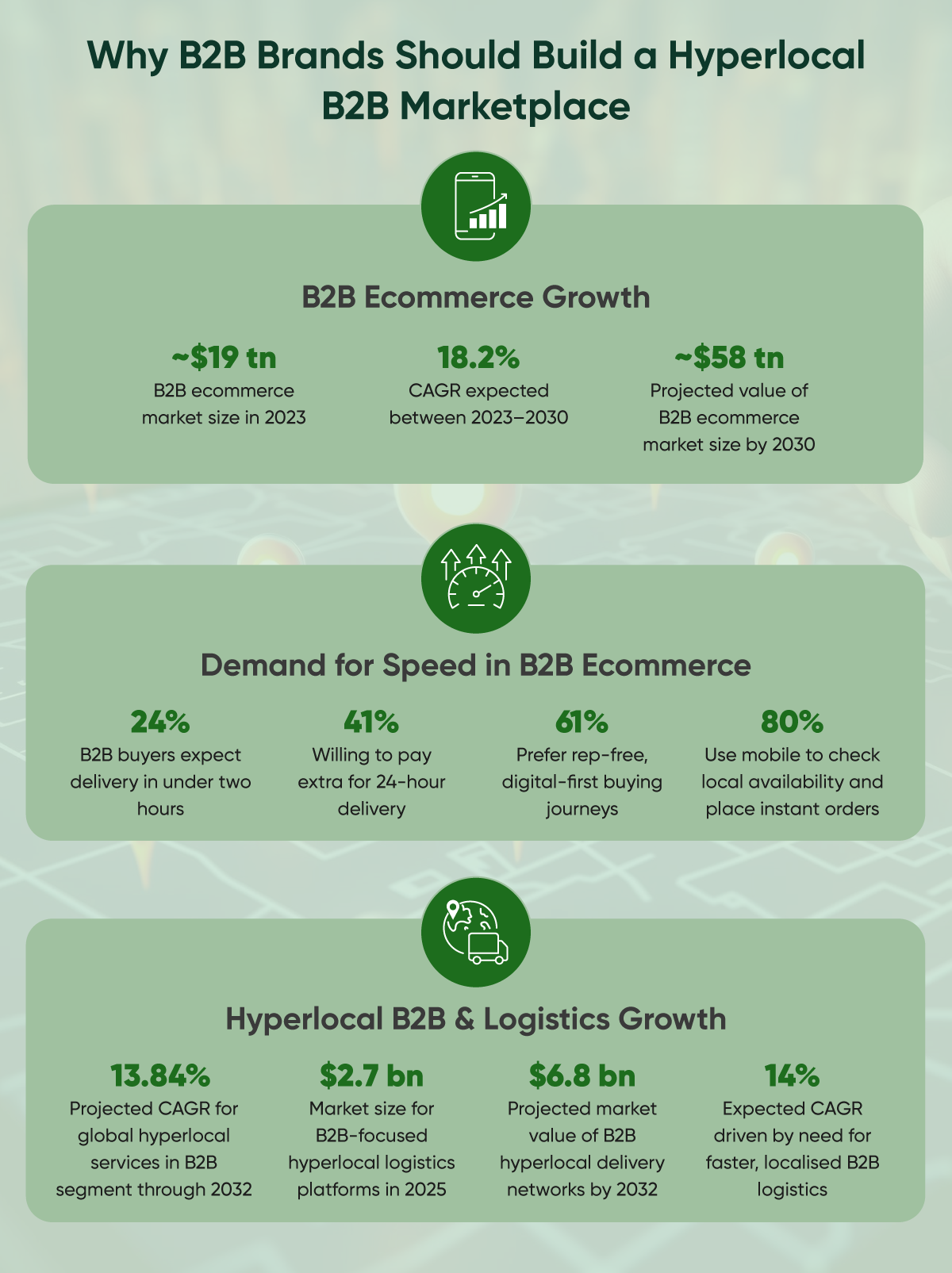
Let’s look at some key data insights that highlight why hyperlocal B2B marketplaces are becoming a growth engine for enterprises:
B2B Ecommerce Growth
- ~$19 trillion B2B ecommerce market size in 2023
- 18.2% CAGR expected between 2023-2030
- ~$58 trillion is projected value of B2B ecommerce market size by 2030
Demand for Speed in B2B Ecommerce
- 24% of B2B buyers expect delivery in under two hours fast delivery
- 41% are willing to pay extra for 24-hour delivery Paid Express Shipping
- 61% prefer rep-free, digital-first buying journeys Self-Serve Buying
- 80% use mobile to check local availability and place instant orders mobile commerce
Hyperlocal B2B & Logistics Growth
- 13.84% projected CAGR for global hyperlocal services in B2B segment by 2032 hyperlocal growth
- $2.7 bn is market size for B2B-focused hyperlocal logistics platforms in 2025
- $6.8 bn is projected market value of B2B hyperlocal delivery networks by 2032
- 14% expected CAGR (2025–2032) driven by need for faster, localised B2B logistics
Source: Grand View Research, Coalition Technologies, Gartner, BCG, Global Information
Well, the above data shows that growth alone isn’t enough. Today’s B2B buyers expect speed, local availability, and a seamless digital experience. A one-size-fits-all approach won’t work. You need to build a distributor-based hyperlocal B2B marketplace that aligns with buyer priorities, regional demand, and operational efficiency. Leveraging hyperlocal strategies can help your business deliver faster, reduce costs, strengthen distributor relationships, and create more personalised buying experiences.
So, how exactly can building a distributor-based hyperlocal B2B marketplace benefit your business? Let’s explore the 7 key advantages that make this approach a game-changer for enterprises looking to scale efficiently and delight their customers.
7 Benefits of Building a Distributor-Based Hyperlocal B2B Marketplace
In an era where convenience and speed are essential, a hyperlocal business-to-business marketplace helps you stay competitive while supporting local distributors. When you build a B2B marketplace with a hyperlocal approach, you get a host of benefits that help improve efficiency and customer satisfaction.
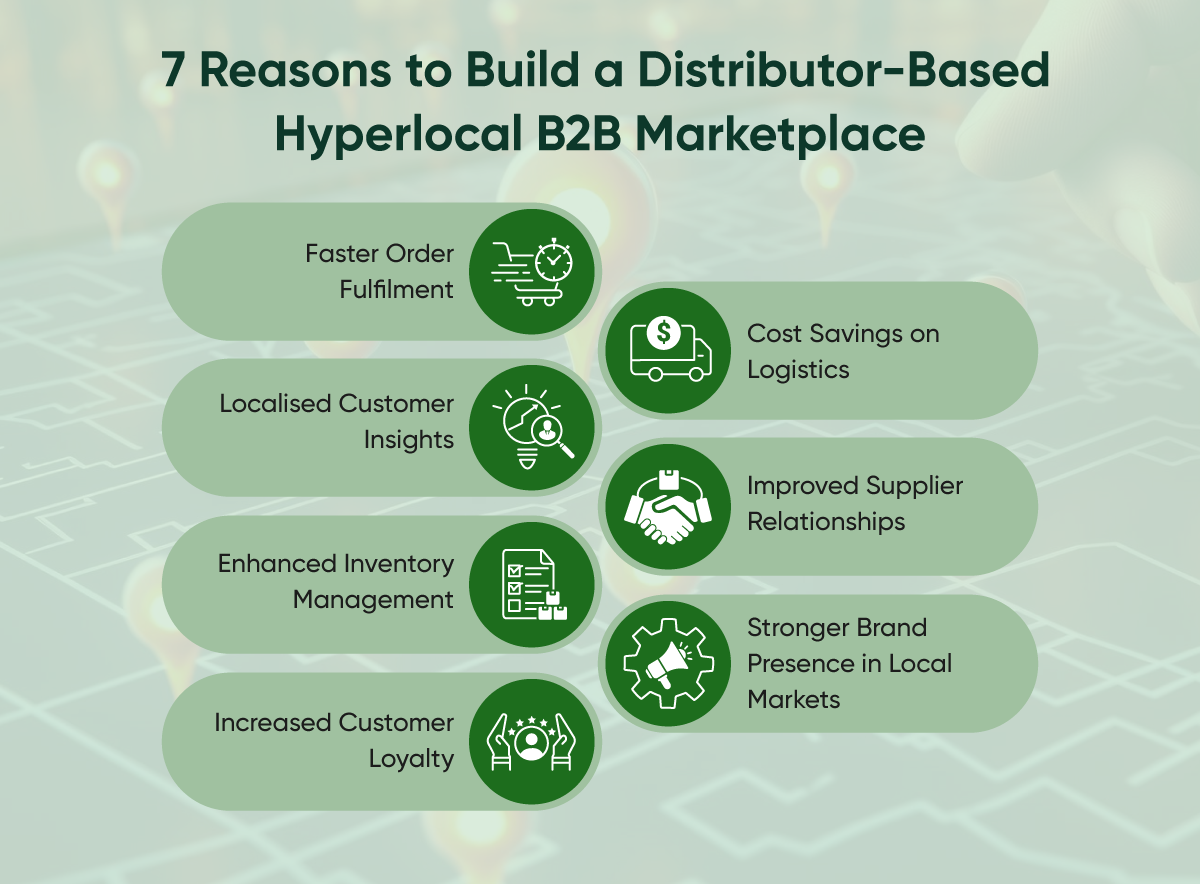
Here are seven benefits of building a distributor-based hyperlocal B2B marketplace:
Here are seven benefits of building a distributor-based hyperlocal B2B marketplace:
1. Faster Order Fulfilment
Building a distributor-based B2B marketplace with a hyperlocal set up helps you deliver faster. Wonder how? Well, it's simple, when you connect your buyers to nearby hyperlocal distributors, you cut down the shipping and delivery window significantly. Unlike the traditional B2B marketplaces, a hyperlocal B2B setup will eliminate the need for long-distance shipments and allow distributors to deliver in record time. With local distributors handling the logistics, you can ensure same-day deliveries, enhance the overall customer experience, and boost your order frequency.
With StoreHippo hyperlocal ecommerce set up, you can align the nearest sellers for submitting RFQ for your clients. This singular change speeds up your fulfillment, saves cost and builds long term relationships with happy clients. StoreHippo offers hassle-free and efficient shipping partners for your B2B business. Your distributors can choose from 30+ pre-integrated logistics providers to align timely deliveries. StoreHippo B2B marketplace solutions also come with a complete delivery management system to help your vendors align their chain of delivery boys for efficient delivery.
2. Cost Savings on Logistics
Well, the logistics of a distributor-based B2B marketplace can be costly. Since products travel long distances. A hyperlocal approach helps you significantly reduce costs. Wonder how? When you go with local distributors, you also get shorter delivery routes, which translates into lower fuel costs and fewer transit fees. Additionally, you can save on packaging and handling expenses, as local distributors don’t need to secure products for long hauls. A hyperlocal ecommerce strategy also allows for more flexible delivery schedules, cutting down on overtime and other additional charges that drive up logistics expenses. You can therefore save costs and adopt an economical and efficient delivery process.
StoreHippo distributor based B2B marketplace solution helps save costs on logistics by routing the order through the nearest distributor/warehouse from the client location. You can seamlessly create multiple B2B stores for different vendors based on their location and leverage the benefits of optimised hyperlocal deliveries. You can significantly reduce delivery costs and time. With StoreHippo’s multi-store ecommerce solutions, you can seamlessly create multiple stores right from your admin dashboard. You can use the single database to allocate products, deals, discounts, shipping, and payment gateways to various sub-stores.
3. Localised Customer Insights
A distributor-based B2B hyperlocal ecommerce marketplace offers unmatched access to localised customer insights. Local distributors have better insights about regional markets, buying patterns and demand surges. These insights can be leveraged strategically for inventory management, demand forecasting and better decision-making to optimise stock levels, and meet customer demand efficiently.
With rich customer insights, you can tailor your offerings and ensure that your hyperlocal ecommerce platform meets specific customer needs. These insights help you understand what products are in demand and how buying patterns vary from one location to another. You can go for targeted marketing on your B2B marketplace and thus adjust your marketing strategies according to your target audience.
For example, Diwali is a huge festival for North and Durga Puja a grand festival for Bengalis. With local insights from the vendors on both the target audience groups, you can prime your distribution accordingly for different regions.
StoreHippo ecommerce solutions come with advanced analytics tools to help you understand the buyer personas with access to rich customer insights. You can also seamlessly integrate your site with various data tools likeGoogle Analytics, Zoho, etc. to gain rich customer data. You can also create dynamic forms to capture marketing insights during various stages of the order process. StoreHippo also helps you integrate with the best analytical tools and provides access to a variety of reports.
4. Improved Supplier Relationships
When you build a B2B marketplace using thedistributor-based model, you strengthen your partnerships effectively. Local partners who are well-attuned to their suppliers, foster a collaborative environment that benefits everyone involved. This close connection simplifies negotiating better terms, managing orders, and restocking products seamlessly on your business-to-business platform. Hyperlocal approach benefits both the suppliers and marketplace administrators, as partners get direct access to a broader customer base. In turn, the B2B marketplace enhances its reputation by delivering dependable, timely service to its customers.
StoreHippoB2B enterprise solutions come with a comprehensive end-to-end vendor dashboardthat eases out the process of onboarding and managing vendors. StoreHippo’s vendor management solution includes an automated vendor onboarding process and offers a separate vendor dashboard for each vendor to give an easy understanding of the inventory and order status. When you ease out the selling process for your suppliers or distributors, you improve your relationship with them. You can also get a complete overview of the day-to-day business operations like sales, revenue, vendor performance, best-selling products etc. by simply logging into theadmin panel.
5. Enhanced Inventory Management
A distributor-based B2B marketplace leverages the unique insights of local distributors who understand regional demand surges and maintain optimal inventory levels accordingly. By accurately anticipating demand patterns, these distributors can quickly restock, ensuring that products are available when needed while minimising the risk of overstocking. This not only helps prevent resource wastage but also allows for a more responsive supply chain, enabling sellers to meet customer demands promptly and efficiently. With the hyperlocal approach, you can save money, improve cash flow, and avoid unnecessary warehousing costs for your business.
StoreHippo B2B marketplace solution offers an end-to-end product management system that saves time and makes your processes faster. You can seamlessly manage products in your backend and storefront with time saving and simple features. You can add, delete, edit, import, export, search or filter, publish or unpublish a single or multiple products in just a few clicks. You can also manage and plan your inventory automatically with simplified inventory management features from StoreHippo. You can get your inventory updated automatically after each new order, return, or order cancellation, and set up options like ”out of stock” to notify your customers about an item that is out of stock on your distributor based B2B marketplace .
6. Stronger Brand Presence in Local Markets
With a hyperlocal distributor-based B2B marketplace setup, you can seamlessly build a stronger brand presence in local markets. Connecting with local distributors not only helps expand your reach but also helps embed your brand into specific communities. Since local distributors understand their markets, they can promote your brand effectively. You can establish a loyal customer base by gaining visibility in the local market. This also helps you position your online marketplace as a trusted, reliable resource that caters to regional needs.
StoreHippo, B2B marketplace solution, comes with user-friendly marketing tools that help you craft tailored strategies and create a stronger brand presence in local markets. With the robust discount engine and coupon code features, you can offer multi-level discounts to your customers in various locations. You can engage your customers in real-time through personalised push notifications or live chat and chatbots. Additionally, StoreHippo's built-in SEO features help you optimise your online marketplace and rank higher on SERPs.
7. Increased Customer Loyalty
A hyperlocal ecommerce approach naturally enhances customer loyalty. By offering faster deliveries and connecting business clients to local distributors, you’re making it easier for your customers to get what they need, as and when they need it. When you engage with distributors from nearby locations, you help your customers create stronger relationships, direct communication, and a more personalised experience. Well, we all know that satisfied customers are more likely to return to your B2B marketplace and recommend it to others.
For example, An electronics brand can enhance customer loyalty by connecting local retailers with nearby distributors, ensuring faster delivery of products like electronics and accessories. The hyperlocal model allows retailers to quickly restock, reduce wait times, and improve operational efficiency.
By fostering direct communication and personalised deals between retailers and local distributors, your B2B marketplace strengthens relationships and enhances satisfaction. As a result, retailers are more likely to become repeat customers and recommend the platform to others, benefiting the overall business ecosystem.
StoreHippo helps you build a B2B marketplace that can seamlessly connect with its customers through automated tools and features like abandoned cart follow-up, SMS, push and email notifications, social media integrations, live chat, chatbot, etc. You can also boost your customer loyalty by offering personalised buyer journeys to your customers. Your buyers can quickly get quotes and compare prices of the products on your ecommerce app. StoreHippo also has a host of B2B features like RFQ, Minimum Order Quantity (MOQ), etc to help customers cut down the negotiation time and make informed decisions on your B2B marketplace. StoreHippo comes with a built-in 3-party buyer-seller-admin chat to facilitate faster negotiations, pricing comparison, tiered pricing, etc. offering a seamless 3-way communication between admin, vendors, and customers.
How StoreHippo AI-Powered B2B Ecommerce Solutions Enable Enterprises To Launch Hyperlocal B2B Marketplace
As distributor-based hyperlocal B2B marketplaces scale, AI-driven personalisation is emerging as a critical differentiator. Enterprises leveraging AI are not only streamlining operations but are delivering smarter, location-based buying experiences that drive higher engagement, faster conversions, and growth.
Here’s how AI adoption is already delivering measurable impact across B2B marketplaces:
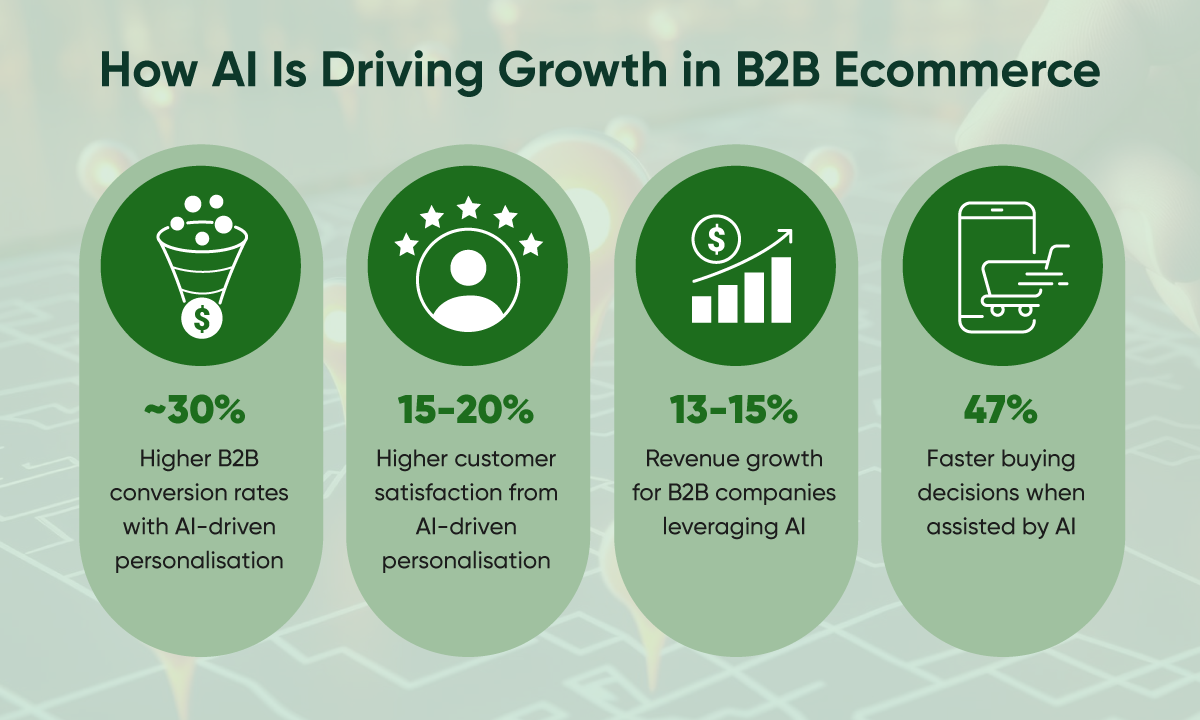
- ~30% higher B2B conversion rates with AI-driven personalisation (McKinsey)
- 15-20% higher customer satisfaction from AI-driven personalisation (McKinsey)
- 13-15% revenue growth for B2B companies leveraging AI ( Persana AI)
- 47% faster buying decisions when assisted by AI (Hello Rep)
These insights make it clear that B2B marketplaces that embed AI into their core operations are better positioned to meet modern buyer expectations around speed, relevance, and convenience. As buying journeys become more digital and localised, AI helps enterprises maintain consistency across regions while delivering personalised experiences at a distributor level.
StoreHippo’s AI solutions align directly with this shift. Here is how StoreHippo B2B ecommerce solutions' AI capabilities empower hyperlocal B2B marketplaces operations for the AI era:
- AI-driven cataloguing: Automates product tagging, categorisation, attribute mapping, and content optimisation across distributor inventories, making large, decentralised catalogues easy to manage and discover.
- Magic Edit for product images: Enhances product visuals to create professional, market-ready images, ensuring catalogue consistency and higher buyer confidence across all hyperlocal stores.
- Intent-based search: Goes beyond keyword matching to surface locally available products based on buyers’ past orders, browsing behaviour, and buying intent.
- Intelligent product recommendations: Helps buyers discover relevant products faster, increasing conversions and repeat purchases in hyperlocal buying journeys.
- Agentic AI buying assistants: Enables enterprises to build Custom agents to guide B2B buyers through RFQs, bulk ordering, price comparisons, and reorders, reducing friction and shortening sales cycles.
- Custom AI assistants for stakeholders: Brands can build agents to support buyers, sellers, and internal teams that streamlines onboarding, manages operations, resolves issues, and handles daily workflows efficiently.
With StoreHippo’s AI-native approach, B2B marketplaces evolve into intelligent, scalable ecosystems that deliver faster fulfilment, higher customer satisfaction, and sustainable growth across local markets, enabling fast and smooth launch of B2B marketplaces.
Conclusion
Building a distributor-based B2B marketplace with a hyperlocal set-up positions your business for success in today’s digital landscape. With the hyperlocal model, you can connect with customers on a deeper level, foster customer loyalty, and drive repeat business.
StoreHippo is a 360-degree, robust ecommerce platform that comes with hyperlocal ecommerce solutions, powered by AI at its core. Built on MACH architecture, StoreHippo helps businesses build out-of-the-box ecommerce solutions while leveraging AI-driven automation, intelligent search, and assisted buying experiences. You can leverage the scalability, flexibility, and extensibility of the API infrastructure to build conversion-oriented B2B marketplaces.
Are you ready to build a B2B marketplace that leverages these advantages and uses AI to deliver faster, more personalised hyperlocal buying experiences, setting your business up for sustainable growth and long-term success with StoreHippo?
Book your custom demo now.
FAQs
1. How does a distributor-based hyperlocal B2B marketplace differ from traditional multi-vendor B2B platforms?
Traditional B2B marketplaces focus on centralised inventory and long-haul fulfilment, which often slows down delivery and increases costs. A distributor-based hyperlocal B2B marketplace decentralises inventory by routing orders through nearby distributors. StoreHippo’s B2B marketplace solutions are purpose-built for this model, enabling location-based seller mapping, hyperlocal order routing, and faster fulfilment without adding operational complexity.
2. Can hyperlocal B2B marketplaces scale across multiple regions without losing control?
Yes, but only with the right platform. Scaling hyperlocal operations manually quickly becomes unmanageable. StoreHippo’s enterprise ecommerce platform enables businesses to manage multiple distributor stores, regions, and inventories from a single admin panel, ensuring consistency while still enabling local flexibility as you build a B2B marketplace across cities or regions.
3. How does a hyperlocal model improve buyer experience in B2B ecommerce?
B2B buyers value speed, reliability, and local availability more than ever. Hyperlocal ecommerce connects buyers directly with nearby distributors, reducing delivery times and improving service responsiveness. StoreHippo enhances this experience further with features like RFQs, local seller discovery, and AI-powered recommendations that align buyers with the most relevant local suppliers.
4. What challenges do enterprises face when onboarding multiple local distributors?
Onboarding hundreds of distributors often leads to fragmented data, inconsistent catalogues, and operational delays. StoreHippo addresses this with simplified vendor onboarding, individual distributor dashboards, and centralised controls along with master catalogue, making it easier to scale a distributor-based B2B marketplace while maintaining governance and transparency.
5. How does hyperlocal ecommerce impact inventory planning for B2B businesses?
Hyperlocal models provide more accurate, region-specific demand signals, helping businesses avoid overstocking or stockouts. StoreHippo’s B2B ecommerce solutions offers inventory updates in real time across distributors, allowing enterprises to respond quickly to local demand fluctuations and fulfill orders.
6. Is a distributor-based hyperlocal B2B marketplace suitable for enterprises with diverse product categories?
Absolutely. Enterprises dealing with multiple SKUs across regions benefit significantly from hyperlocal distribution. StoreHippo supports complex catalogue structures, multi-category management, and distributor-specific product visibility, making it easier to manage large, decentralised catalogues within a single B2B marketplace ecosystem.
7. How does AI strengthen hyperlocal B2B marketplace operations?
AI plays a critical role in managing scale and complexity. StoreHippo’s AI-powered B2B ecommerce platform automates catalogue management, improves product discovery through intent-based search, and personalises buyer journeys at a local level, helping enterprises deliver relevance and speed without manual intervention.
8. Can hyperlocal B2B marketplaces reduce dependency on sales teams?
Yes. Self-serve features like instant RFQs, tiered pricing, and AI-driven buying assistants allow buyers to make faster decisions without constant sales involvement. StoreHippo enables this shift by embedding assisted buying workflows directly into the marketplace, freeing sales teams to focus on strategic accounts rather than routine transactions.
9. How does a hyperlocal B2B marketplace help build long-term distributor loyalty?
Local distributors benefit from increased visibility, faster order cycles, and simplified operations. StoreHippo strengthens distributor relationships through transparent dashboards, streamlined order management, and automated communication tools, making the marketplace a valuable growth channel rather than just a sales platform.
10. What should enterprises prioritise when choosing a platform to build a hyperlocal B2B marketplace?
Enterprises should look for flexibility, scalability, and native hyperlocal capabilities, not bolt-on solutions. StoreHippo stands out by offering AI-native B2B marketplace solutions, hyperlocal order routing, multi-store management, and enterprise-grade extensibility, making it easier to build, scale, and future-proof a distributor-based hyperlocal B2B marketplace.