


The multi vendor marketplace model that helped you grow a few years ago may not be enough to meet today's ecommerce demands.
Buyer expectations have undergone a major shift. Customers want to discover products, ask questions, and complete purchases through WhatsApp, voice, or AI-powered conversations instead of relying only on traditional product pages. Sellers expect to manage their business from their smartphones, while enterprises need the flexibility to run B2B, B2C, D2C, and other business models from a single platform.
The fastest-growing marketplaces today are not just adding new features. They are choosing platforms that can adapt to changing buyer expectations, simplify operations, and support long-term growth.
Table of Contents
- 7 Proven Ways To Future-Proof Your Multi Vendor Marketplace
- 1. Why Your Multi Vendor Marketplace Should Use AI Automation Across Every Layer?
- 2. Have You Built a Unified Omnichannel Brand Presence to Scale Your Multi Vendor Marketplace?
- 3. Is Your Marketplace Truly Mobile-First for Both Buyers and Sellers?
- 4. Can you experiment with multiple business models on your Multi Vendor Marketplace Without Rebuilding your tech stack?
- 5. How Can Faster Deliveries Become a Competitive Advantage for Your Multi Vendor Marketplace?
- 6. Can Buyers Shop Through WhatsApp, Voice and AI Assistants on Your Marketplace?
- 7. How Does Your Marketplace Handle Support for Both Vendors and Buyers Without Increasing Support Costs?
- Conclusion
- FAQs
7 Proven Ways To Future-Proof Your Multi Vendor Marketplace
Every enterprise online marketplace should have these seven capabilities to stay competitive and future-ready in 2026 and beyond.
Let's explore one by one.
1. Why Your Multi Vendor Marketplace Should Use AI Automation Across Every Layer?
AI delivers the most value when it powers the entire marketplace, not just individual tasks. Applying AI across every layer, from seller onboarding and catalogue creation to pricing, inventory, order management, search, recommendations, order processing, and customer support reduces manual effort, improves decision-making, speeds up operations, and creates a more consistent experience for both sellers and buyers.
Instead of using AI only for buyer-facing features, leading enterprise marketplaces are embedding AI across every operational layer to improve efficiency, reduce manual effort, and scale faster.
Lets see how AI is revolutionising modern ecommerce.
AI Automation Across the Ecommerce Space
- Experts expect agentic AI to influence nearly 75% of enterprise ecommerce operations by 2026. AI is now the core part of how marketplaces automate and manage daily operations.
- AI-powered product recommendations can generate up to 31% of ecommerce revenue. For marketplaces with thousands of vendors and SKUs, AI automation is a significant growth driver.
- AI-driven personalisation can increase revenue by up to 40%. Personalised content and recommendations can improve conversion rates by as much as 369% for marketplaces with large product catalogues.
Source IBM
AI becomes even more important as marketplaces expand their sellers, product catalogues, and day-to-day operations.
Imagine a fashion marketplace onboarding hundreds of new sellers every month. Each seller uploads product data in a different format, uses inconsistent product titles, and uploads low-quality images. If the marketplace team has to review, categorise, edit, and publish every listing manually, onboarding slows down and product quality becomes inconsistent.
This is where AI can make the biggest difference. It can automatically create product catalogues, improve product images, enhance product information, recommend relevant products, offer personalised results, route orders more efficiently, identify fulfilment issues early, and even assist support teams with daily workflows. Instead of spending time on repetitive tasks, teams can focus on growing their business.
StoreHippo is an AI powered multi vendor marketplace platform where AI is built into its core. It offers AI semantic search, an AI image editing tool, Magic Edit, AI-powered cataloguing, intelligent product recommendations and search, and enables brands to build custom agentic AI assistants to automate operations without relying on multiple third-party tools.
2. Have You Built a Unified Omnichannel Brand Presence to Scale Your Multi Vendor Marketplace?
A unified omnichannel strategy enables multi vendor marketplaces to manage every sales channel from a single unified backend. This keeps inventory, pricing, orders, promotions, and customer experiences consistent across websites, mobile apps, WhatsApp, social commerce, offline stores, AI chat interface, and other conversational channels while simplifying operations and supporting seamless growth.
Lets have a look at some data highlighting omnichannel ecommerce growth.
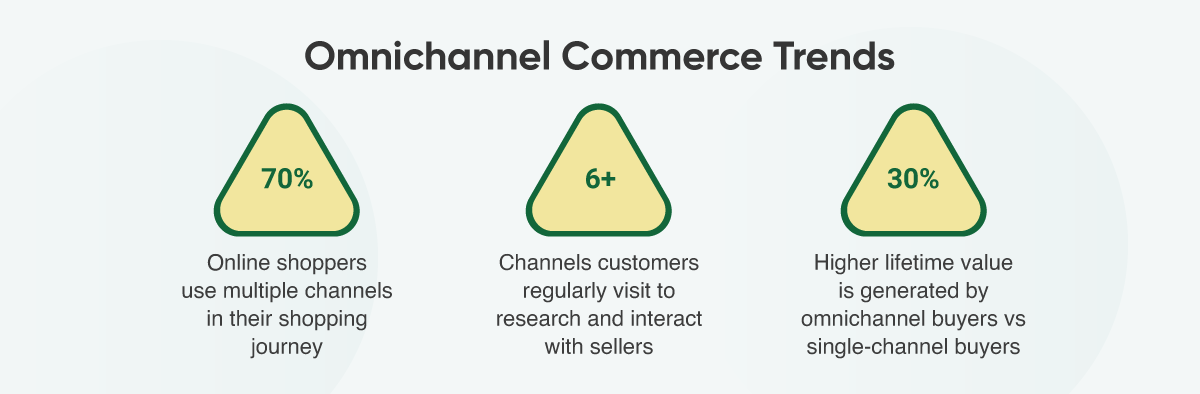
- 70% of online shoppers use multiple channels in their shopping journey
- 6+ channels customers regularly visit to research and interact with sellers
- 30% higher lifetime value is generated by omnichannel buyers vs single-channel buyers
Source Uniform Market, eMarketer
People don't think in channels anymore. They simply expect the same smooth experience wherever they choose to shop. Brands that deliver it earn more trust and win more sales.
Let's take the example of a home furniture marketplace selling through its website, mobile app, WhatsApp, and offline stores. A customer finds a sofa at a discounted price on the website but sees a different price on the mobile app. They then visit a nearby store, only to find the sofa is out of stock, even though it was available online. Such inconsistencies create confusion, reduce customer trust, and often result in lost sales.
A unified commerce backend eliminates these gaps by keeping every sales channel synchronised in real time. Inventory, pricing, promotions, vendor information, and orders stay updated across every customer touchpoint, allowing buyers to enjoy a seamless experience while teams manage everything from a single platform.
StoreHippo online marketplace solution is built on a headless architecture that helps enterprise brands create a unified omnichannel presence. Whether businesses sell through websites, mobile apps, social commerce, physical stores, or conversational AI channels, every storefront runs on the same backend. This ensures consistent pricing, inventory, promotions, and vendor data across every channel without additional development or manual coordination.
3. Is Your Marketplace Truly Mobile-First for Both Buyers and Sellers?
Mobile-first commerce is transforming how multi vendor marketplaces operate by making it easier for both buyers and sellers to manage everything on their smartphones. Instead of using mobile only for shopping, leading enterprise marketplaces also enable sellers to manage products, inventory, orders, and payments from anywhere, making operations faster and easier to scale.
Let's have a look at how mobile is shaping modern ecommerce.
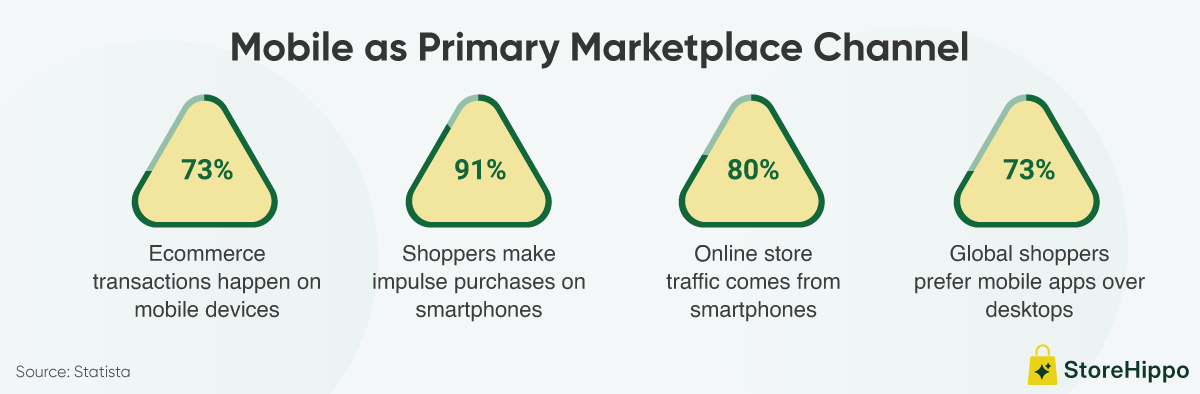
- 73% of ecommerce transactions happen on mobile devices
- 91% of shoppers make impulse purchases on smartphones
- 80% of online store traffic comes from smartphones
- 73% of global shoppers prefer mobile apps over desktops
Source : Statista
As mobile becomes the preferred way to shop online, businesses also need to ensure sellers can manage their marketplace operations with the same level of convenience.
Imagine a handicrafts marketplace where small artisans sell their products online. Many of them don't work from an office or use a desktop every day. With a mobile app, they can upload new products, accept orders, update stock, and track payments from anywhere, making it easier to manage their business and serve customers faster.
A mobile-first marketplace empowers sellers to respond faster while helping buyers enjoy a seamless shopping experience. This improves product availability, speeds up order processing, and enables marketplaces to operate more efficiently as they grow.
StoreHippo online marketplace solution is built on a mobile-first architecture that offers a no-code mobile app builder that lets enterprise brands launch separate Android and iOS apps for buyers and sellers from the same admin dashboard. Businesses can also create dedicated apps for different brands, regions, etc., while built-in Progressive Web Apps (PWAs) deliver app-like experiences across devices. Vendors can manage products, inventory, orders, and payments directly from their smartphones, enabling faster operations without depending on a desktop.
4. Can you experiment with multiple business models on your Multi Vendor Marketplace Without Rebuilding your tech stack?
A multi vendor marketplace solution that supports multiple business models can help enterprise brands expand into B2B, B2C, D2C, B2B2C, hyperlocal, and hybrid commerce without requiring separate platforms or major redevelopment. This gives businesses the flexibility to launch new revenue channels, serve different customer segments, and scale faster from a single commerce backend.
Most multi vendor marketplaces start with a single business model. As the business grows, so do customer expectations and new revenue opportunities. An enterprise that starts with a D2C store may later expand to dealer networks, add B2B wholesale, or launch hyperlocal delivery in new cities. If the ecommerce platform can't support these changes, the enterprise has to invest in additional systems, custom development, and longer implementation timelines.
Let's take the example of a consumer electronics brand that initially sells directly to customers online. As the business grows, it starts selling through authorised dealers, accepts bulk orders from businesses, and offers same-day delivery in major cities. It now needs to manage different pricing, fulfilment rules, and order workflows for each customer segment while operating everything from a single platform.
A flexible marketplace platform with multi-model support can simplify this complexity by managing flexible pricing, fulfilment workflows, customer segments, and sales channels from one system. This reduces operational overhead, eliminates duplicate systems, and makes expansion faster and easier.
StoreHippo natively supports multiple business models. Enterprises can easily pivot to any business model, including B2C, B2B, D2C, B2B2C, hyperlocal, and hybrid commerce models without requiring platform rebuilds or third-party integrations. They can configure model-specific pricing, fulfilment workflows, tax rules, and customer journeys while managing all commerce operations through a unified backend.
5. How Can Faster Deliveries Become a Competitive Advantage for Your Multi Vendor Marketplace?
Faster deliveries become a competitive advantage when a multi vendor marketplace can optimise order routing, seller allocation, and logistics from a single platform. This helps enterprises reduce delivery times, improve fulfilment efficiency, and deliver a reliable post-purchase experience that drives customer satisfaction and repeat purchases.
New-age buyers compare every shopping experience with the fastest delivery they've ever received, regardless of the brand or marketplace. For a multi vendor marketplace, meeting those expectations is more challenging because every seller has different inventory locations, fulfilment processes, and delivery partners.
Imagine a customer ordering a mobile phone, a charger, and headphones from three different sellers on your marketplace. The customer expects quick delivery and regular order updates. If the marketplace takes too long to process the order or chooses the wrong delivery partner, deliveries can get delayed, and the overall shopping experience suffers.
StoreHippo AI powered multi vendor marketplace platform comes pre-integrated with 30+ logistics partners for global fulfilment. Businesses can automatically assign orders to the most suitable dealer or delivery partner based on stock availability, location, and delivery timelines. They can also manage deliveries and track orders from a single platform.
6. Can Buyers Shop Through WhatsApp, Voice and AI Assistants on Your Marketplace?
Conversational commerce enables buyers to discover products, ask questions, compare options, and complete purchases through WhatsApp, voice assistants, and AI-powered chat interfaces. Instead of relying only on websites or mobile apps, leading enterprises have already started to expand their marketplaces across conversational channels to deliver faster, more personalised shopping experiences.
Let's explore how conversational AI is changing the way people shop online.
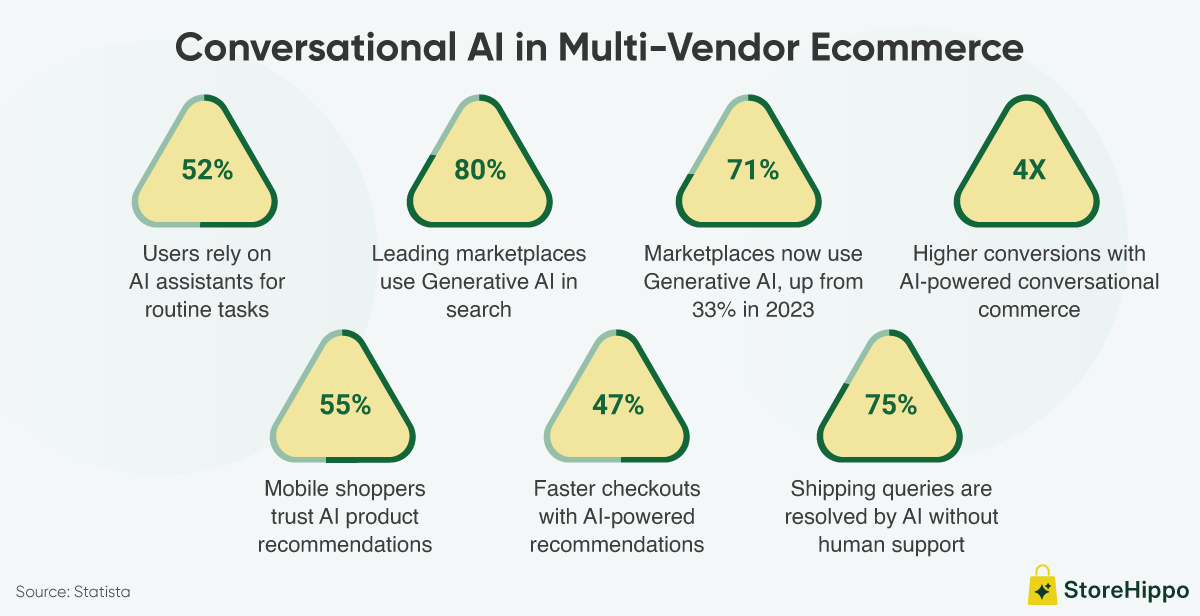
- 52% of users rely on in-app AI assistants to automate repetitive tasks
- 80% of top global multi vendor marketplaces now use Generative AI in core mobile search and discovery
- 71% adoption of Generative AI within marketplace apps jumped from 33% in 2023
- 4X conversion lift for multi-vendor apps using AI-powered conversational commerce
- 55% of mobile shoppers trust AI to shortlist marketplace products
- 47% faster checkouts enabled by AI-powered recommendations in marketplace apps
- 75% of multi-vendor shipping and tracking queries are now resolved by AI without human support
Source: Statista, Vention
As buyers increasingly prefer natural, conversation-based shopping experiences, online marketplaces need to make product discovery and purchasing as simple as sending a message or asking a question.
Take the example of a customer looking for running shoes. Instead of scrolling through hundreds of products, they simply ask, "Show me black running shoes in size 9." The marketplace finds matching products and helps them complete the purchase much faster.
Conversational commerce removes friction from the buying journey by enabling buyers to search, discover, and purchase products through referred channels. This creates a faster shopping experience, improves engagement, and encourages repeat purchases.
StoreHippo's AI powered multi vendor marketplace platform supports conversational commerce through WhatsApp, voice commerce, and a custom-built AI shopping assistant. Buyers can search for products, ask questions, reorder previous purchases, and complete purchases through their preferred channel, while inventory, pricing, and order information stay updated across every touchpoint.
7. How Does Your Marketplace Handle Support for Both Vendors and Buyers Without Increasing Support Costs?
The most effective way to support both buyers and sellers without increasing costs is by using AI-powered automation. AI can resolve routine queries instantly, assist support teams with relevant information, reduce response times, and deliver faster, more consistent support as your marketplace grows.
As your multi vendor marketplace grows, support requests increase too. More sellers, buyers, and orders create more questions about deliveries, returns, payments, commissions, and products. Instead of expanding your support team every time your marketplace grows, you need a smarter way to manage customer queries.
Take the example of a customer who contacts support because an order hasn't arrived. At the same time, the seller wants to know why the payment is still pending. If support agents have to switch between different systems to find the answer, resolving the issue takes longer. Both the buyer and the seller end up waiting, leading to frustration and lower trust in your marketplace.
AI-powered support brings customer, seller, and order information together in one place, allowing routine queries to be resolved automatically while giving support teams the context they need to handle complex issues faster.
StoreHippo's AI-powered multi vendor marketplace platform enables enterprises to build custom AI support agents for buyers, sellers, and internal teams. Enterprises can build custom AI support bots for sellers to guide them through setup, daily operations, and business growth with real-time, personalised support at every step. Enterprises can also build custom agentic AI assistants that provide real-time query resolution and offer guided buying journeys for customers.
Conclusion
Building a successful multi vendor marketplace isn't just about launching quickly. It's about choosing the right enterprise ecommerce platform that can support your business as it grows, whether you're adding new sellers, expanding into new markets, launching new business models, or delivering better buyer experiences.
These seven capabilities help online marketplaces scale faster, improve operations, and meet changing customer expectations. The more of these capabilities your platform already supports, the easier it becomes to grow without adding unnecessary complexity.
With 300+ enterprise-grade features, 150+ integrations, and 350+ APIs, StoreHippo provides everything enterprises need to build, manage, and scale a future-ready multi vendor marketplace. Built on AI-native, headless, and cloud-native architecture, StoreHippo is designed to support the changing needs of modern enterprise marketplaces, from launch to large-scale growth.
If you're planning to launch a new marketplace, schedule a demo with StoreHippo now.
FAQs
Q1: What is a multi vendor marketplace and how is it different from a regular ecommerce store?
A multi vendor marketplace hosts multiple independent sellers under one platform, each managing their own listings, pricing, and, in some cases fulfilment while the platform owners or admins manage onboarding, commissions, dispute resolution, and the overall buyer experience. Multi vendor marketplaces create significantly more operational and technical complexity than single-brand stores, particularly around payment splitting, vendor-level SLA management, and consistent buyer experience across heterogeneous seller quality.
Q2: How long does it take to build and launch a multi vendor marketplace in 2026?
Businesses can typically build and launch a multi vendor marketplace in 6-8 weeks using a modern, composable ecommerce platform with built-in multi-vendor capabilities. The exact timeline depends on your business requirements, such as seller onboarding, payment and logistics integrations, custom workflows, and support for features like flexible pricing, multiple languages, or multiple currencies.
Q3: What technology stack does an enterprise multi vendor marketplace need in 2026?
An enterprise multi vendor marketplace in 2026 should use a modern technology stack based on MACH architecture (Microservices, API-first, Cloud-native, and Headless). It should also offer a mobile-first experience, native AI and omnichannel capabilities, and support multiple business models. These features help businesses scale faster, adapt quickly to changing customer needs, and reduce custom development.
Q4: How do multi vendor marketplaces handle payment splits and vendor payouts?
Multi vendor marketplaces handle payment splits by collecting the buyer's payment, automatically deducting platform commissions, and routing the remaining amount to each vendor. Modern marketplace platforms support automated split payments, scheduled vendor payouts, and payment tracking, enabling secure transactions, accurate settlements, and smooth financial operations even when multiple vendors fulfil a single order.
Q5: Can a multi-vendor marketplace run B2B and B2C operations on the same platform simultaneously?
Yes. A modern multi vendor marketplace can run B2B and B2C operations on the same platform by supporting separate storefronts, pricing, catalogues, payment terms, and buying journeys for different customer segments. This enables businesses to serve wholesale and retail buyers efficiently while managing operations from a single backend.
Q6: How is conversational commerce changing how buyers interact with marketplaces?
Conversational commerce transforms marketplace interactions by allowing buyers to discover products, ask questions, receive personalised recommendations, and complete purchases through natural conversations. AI-powered shopping assistants understand buyer intent and provide instant, relevant responses, making product discovery faster, reducing purchase friction, and improving conversion rates and customer satisfaction.